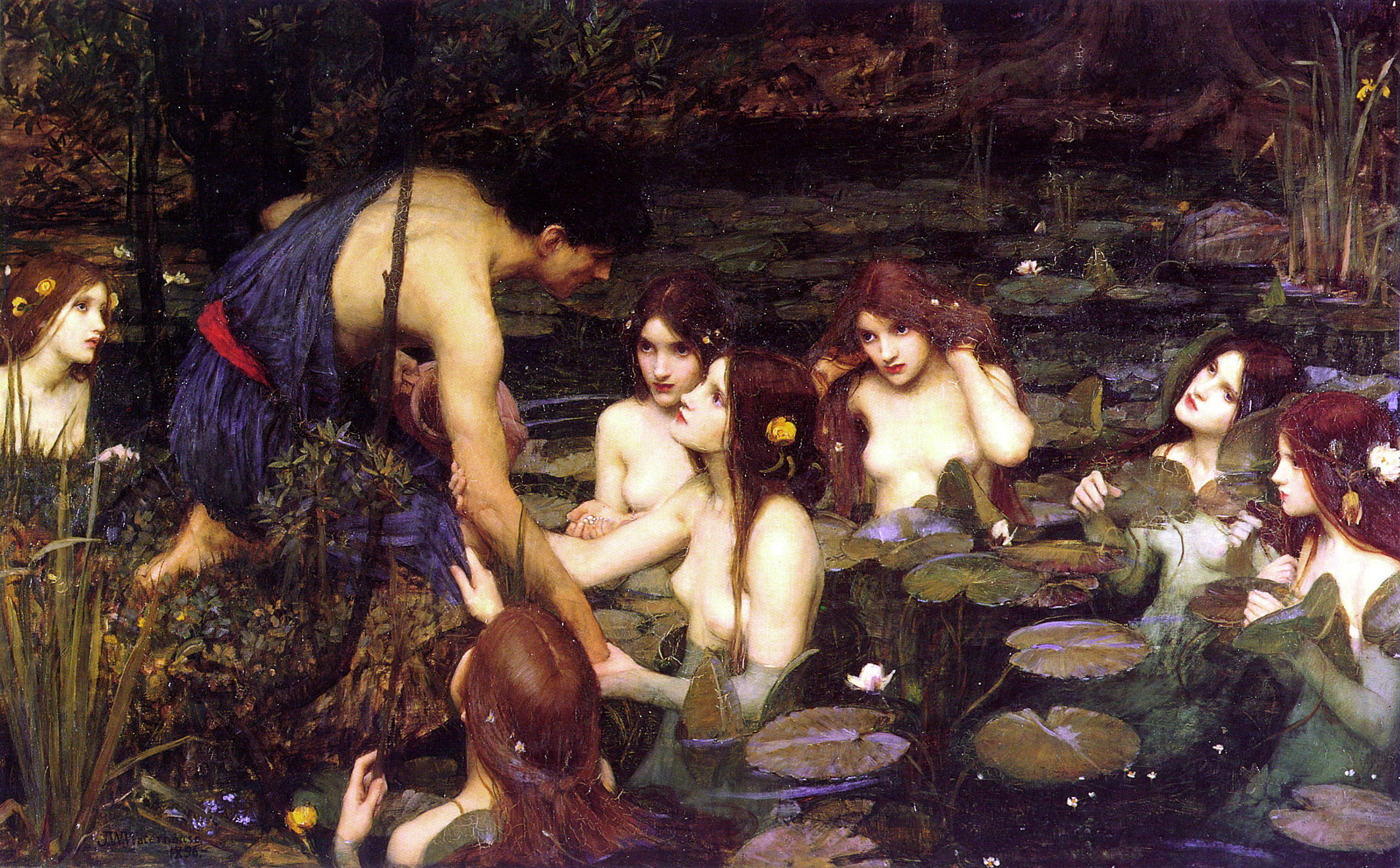
Undine – The Spirit Bound to Water

Introduction

Undine is one of the spirits bound to water: imprisoned in the depths of lakes, springs, and forgotten wells, halfway between a free soul and a ghost chained to its element. She yearns for freedom, touch, and voice, but behind every approach lurks the silent, suffocating embrace of the water.

Most wanderers only hear of her: soft singing from the fog, light beneath the water’s surface, a female form at the edge of the water. Those who are too curious do not always return.

Species and Essence

Undine is not a simple ghost, but a consciousness bound to water:

  • does not possess a fully physical body,
  • yet is not a “dead soul” – rather an interrupted life, an unfinished fate that the water does not release.

According to many stories, Undine was once human: – a bride who drowned in water, – a nun fleeing from a monastery, – or a mage who experimented with the elemental power of water and eventually became lost in her own spell.

Other legends hold that Undine was born as a spirit from the beginning, as a crystallized fragment of the water’s “will” – with emotions, but without bodily existence.

Origin and Legend

Most chronicles mention three types of Undine:

  1. Lake Undine – lives at the bottom of calm, deep-water lakes. Her song is pure, almost sorrowful melody that resonates from loneliness and unfulfilled desires. They are sometimes described as helpful: they save those who approach the water with respect.
  2. Spring Undine – appears around mountain springs and healing waters. According to legend, she can heal, but healing has a price: something must always be left at the water – a secret, a memory, or a promise.
  3. Well Undine – lives in forgotten wells, in the depths of urban ruins. They are the most dangerous: due to their long solitude, they often become insane. Their laughter echoes between the well walls, and they promise that whoever descends to them will “never be alone again.”

In every variant, it is common that Undine, for some reason, could not or did not want to cross over to the afterlife. The water became both her prison and her home.

Appearance

Undine rarely shows herself fully. Those who have seen her describe her similarly:

  • delicate, feminine form, as if a young girl, with long hair floating in the water,
  • her attire is more like a water curtain, strands of algae, and a play of light and shadow, rather than real material,
  • her skin is pale, slightly translucent, as if drawn by the reflection of the water’s surface,
  • her eyes are deep, in shades of blue or green – sometimes glowing like the moon on the water’s surface, sometimes completely dark.

Sometimes only details are visible:

  • a hand from the muddy shore,
  • a face beneath the water’s surface,
  • a form in the fog, which is nowhere a moment later.
 

Abilities and Effects

Undine’s power is tied to water and emotions.

Water Manipulation

She does not rule the oceans, but in her own “territory” – at a lake, spring, or well – she is capable of:

  • rippling, raising the water,
  • opening ditches or whirlpools,
  • changing the temperature to cold, bone-chilling cold,
  • summoning fog or mist to hide herself.

Emotional Mirroring

Undine “reads” the approacher through touch and gaze:

  • amplifies the desire for freedom, love, or forgiveness,
  • brings suppressed guilt, fear, or hope to the surface,
  • returns them as an echo – in the form of sound, vision, or dream.

This is why she is considered both dangerous and healing: those who cannot face themselves easily crumble under the weight of the mirrored emotions.

Sound and Call

Undine’s song or whisper:

  • from afar is beautiful and soothing,
  • up close, however, often compelling: whoever hears it feels they must go closer to the water, look into the depths.

Weaknesses and Survival Tips

Undine is not invincible. There are methods to avoid her wrath – or survive the encounter.

Weaknesses:

  • strong, pure will – those who consciously say no to the call are rarely pulled down,
  • consecrated or blessed objects – some Undines retreat from them, as they remind them that they should move on,
  • flowing water – most Undines are bound to still water; in rivers, they are weaker or do not appear at all.

Survival Tips:

  • do not stare long into the water’s mirror if you hear strange singing,
  • do not lean too close to the well’s edge if you think you hear sounds from the depths,
  • never promise something to the water (or yourself) that you cannot keep – Undine lives from the echo of promises.

Related Relics and Legends

Although Undine is not necessarily the spirit of objects, the chronicles mention several relics connected to her:

  • Silver medal enclosing a drop of water – its wearer may attract Undine’s attention in dreams, sometimes receiving protection, sometimes unpleasant honesty in return.
  • Well rings and old bucket handles – according to urban legends, certain objects made from well metal still “remember” Undine, and occasionally pulse coldly on the wearer’s wrist.

These artifacts are rare, and it is not always clear whether they bring blessing or curse. One thing is certain: whoever chooses a relic connected to Undine’s world will see not only the surface but also themselves more deeply in the mirror of the water.

Basic Definition & Name Origin

Name and Origin

The word undine comes from the Latin unda (“wave, water”); it roughly means “little wave,” “water maiden.” It did not emerge from folk tales, but was invented by a 16th-century alchemist-physician, Paracelsus: he used the name Undina for female spirits belonging to the water element. In his system, the undine is the elemental of water: humanoid, mostly invisible, soulless, but if it marries a human, it gains a mortal soul.

Ancient and Medieval Roots

Although the name itself is from the modern era, the image behind it is very ancient. In ancient Greek and Roman myths, water nymphs (naiads, nereids, oceanids) already appear, who are spirits of rivers, springs, and seas. They dance on the waves, seduce, heal, sometimes dissolve back into water if pursued or harmed – this is the motif upon which the later undine’s “return to water” is built. In the Middle Ages, Christian interpretations often made water spirits darker (seductive, dangerous demons), and Paracelsus gathered this scattered tradition into a system intended to be “scientific”: gnomes (earth), sylphs (air), salamanders (fire), and undines (water).

Romanticism and the Tragic Water Bride

The undine’s true “modern face” was born in 19th-century Romanticism. In Friedrich de la Motte Fouqué’s work Undine (1811), the undine is a water nymph who marries a knight, Huldbrand, to gain a soul. After the marriage, she truly becomes more “human,” but when the man becomes unfaithful, according to the laws of water, the relationship turns to tragedy: the undine returns to the water folk, and with a final kiss brings death to the husband. This story inspired, among others, Andersen’s The Little Mermaid, where the mermaid also struggles between love and soul. In the Romantic era, the undine figure was often interpreted as a symbol of female dependence and subordination: she can only obtain a soul through a man, and the man’s infidelity seals her fate.

20th Century: Theater, Music, and “Ondine’s Curse”

In the 20th century, the undine increasingly became a literary and stage figure. Jean Giraudoux’s play Ondine, followed by ballets and operas, adapted the story, sometimes as a lyrical love drama, sometimes as a darker, psychological tale. From the same myth comes the so-called “Ondine’s Curse” designation: doctors used this name for a rare breathing disorder (central hypoventilation syndrome), alluding to the curse in which the man only breathes as long as he is awake – if he falls asleep, he “forgets” to breathe and dies. In the era of psychoanalysis and feminist readings, the undine was often regarded as a mirror of repressed female desires, the “voice-seeking” female soul, or indeed the female figure exploited and then discarded by men.

Present Day: Pop Culture and New Interpretations

In the 21st century, the undine has appeared in films, animes, and games: sometimes as a water-wizard girl (water shield, healing, flowing magic), sometimes in a darker, monster-like form. The myth is increasingly read from ecological and female “empowerment” perspectives: the spirit of water, who not only begs for a soul but is an independent force that reminds us that water – and with it the world – cannot be exploited without consequence.

Modern: An Erotic Nymph

In dark fantasy and erotic myth, she is desire made fluid: love that can heal… or drown.


Character, Personality, and Symbolism

  • Character/Personality: Seductive, playful, mischievous, but loyal and vengeful. Proud, emotionally stable, empathetic; cheerful in their own circle, serious with strangers. Soulless → they long for love; infidelity: deadly curse (stopping breathing during sleep), Supportive, caressing comfort.
  • Symbolism: Water femininity (fertility, intuition, emotions); gaining a soul through relationships; loyalty vs. betrayal; water dangers (drowning, dependency). Modern: Empathy, creativity, but hypersensitivity (tearing up, depression).

4. Depiction (Appearance and Visual Elements)

  • Classical: Beautiful woman, long blue/wavy hair, translucent skin, water elements (scales, fins); singing, seductive. Art: Waterhouse Undine (1872), Rackham illustrations (1909).

Alternatives in Other Cultures and Folk Traditions The water nymph archetype is universal. Enumeration:

  • Greek/Roman: Nereids (marine), Naiads (springs), Oceanids (oceans).
  • Celtic: Selkies (seal-skinned women, loyalty curse).
  • Japanese: Kappa (water demon, cucumber-hater), Mizuchi (dragon-nymph).
  • Indian: Apsaras (heavenly dancing nymphs, desire-seducers).
  • African: Mami Wata (water mother, fertility goddess).
  • Native American: Deer Woman (seductive spirit).
  • Scandinavian: Neck (water music spirit).

The Undine is a pop culture icon: romantic nymph, soul-seeker. Tabular summary (up to 2025):


CategoryExamplesDescription
LiteratureUndine (Fouqué, 1811); The Little Mermaid (Andersen, 1837); Ondine (Giraudoux, 1939); Undine geht (Bachmann, 1961); Pelléas et Mélisande (Maeterlinck, 1892).Romantic tragedy: gaining a soul through marriage, infidelity curse.
Films/TVOndine (2009, Neil Jordan); Black Mirror (“White Bear”, undine motif); The Little Mermaid (Disney, 1989/2023).Modern: Irish fairy tale, mermaid adaptations.
GamesUndertale (2015, Undyne character); Delicious in Dungeon (2024, undine monster); Black Clover: Quartet Knights (2018).Warrior undines, water spirits.
Anime/MangaBlack Clover (2017–, Undine spirit with Noelle); Delicious in Dungeon (2024); Monster Musume (water nymphs).Shonen: spirit contract, battle.
Music/BalletHoffmann opera (1816); Henze Ondine ballet (1958, Fonteyn); Debussy Ondine (1908); Reinecke Undine Sonata (1882).Romantic: loyalty theme.


Oops! Brána je zamknutá...

Zdá sa, že ste príliš mladý na to, aby ste vstúpili do sveta Fantasy Dragon. Ale nebojte sa, draci sú trpezliví a budú na vás čakať, keď príde čas! Dovtedy sa vydajte za dobrodružstvom do iných ríš!

 „Ahoj, malý dobrodruh! Si pripravený preskúmať mystický svet Fantasy Dragon?! Máš pravdu ;)

Do ríše Fantasy Dragon môžu vstúpiť len odvážni a zrelí draci. Overte si prosím svoj vek!

„Ahoj, malý dobrodruh! Si pripravený preskúmať mystický svet Fantasy Dragon?! Máš pravdu ;)

Do ríše Fantasy Dragon môžu vstúpiť len odvážni a zrelí draci. Overte si prosím svoj vek!